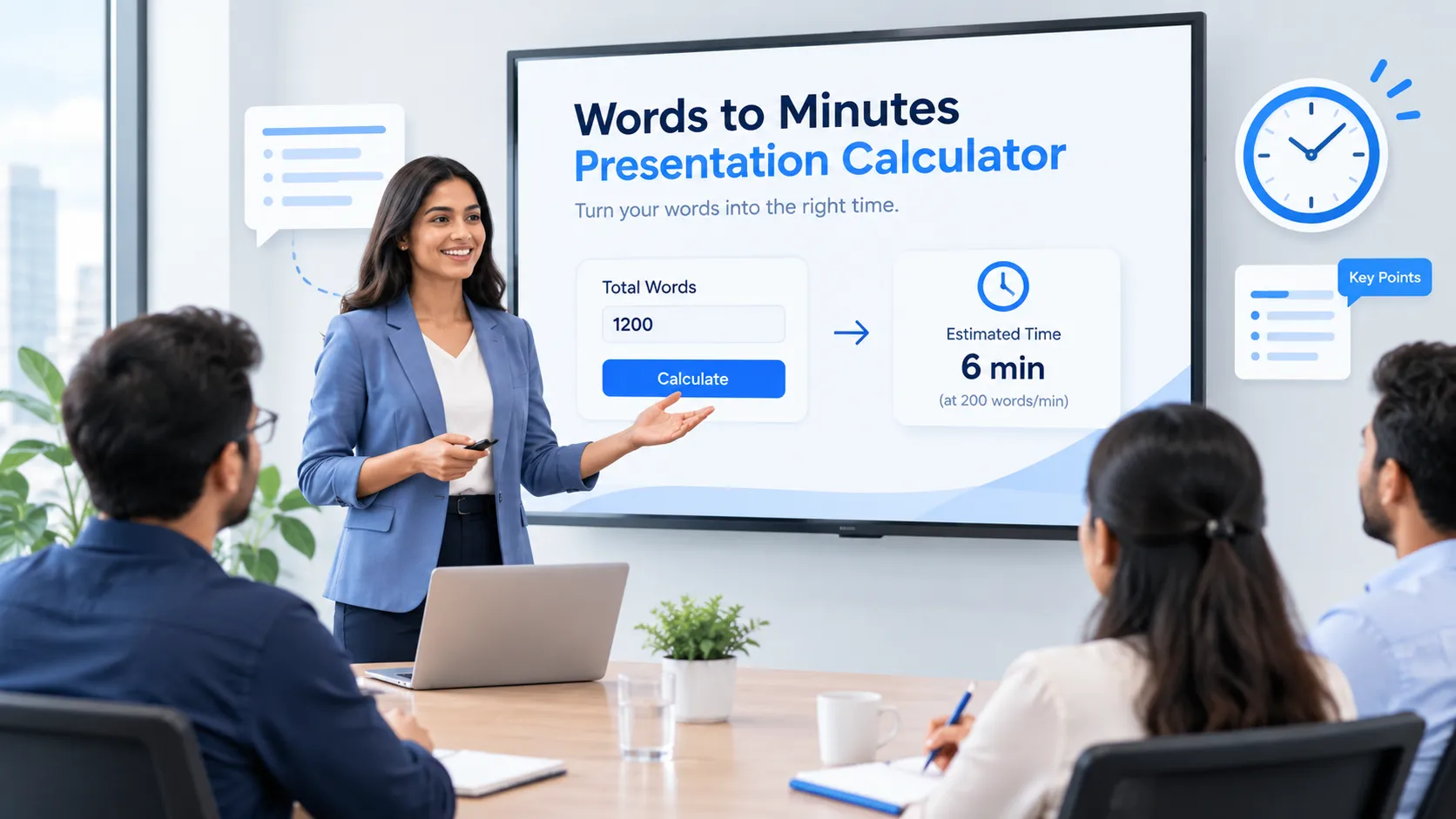
What is a words to minutes calculator?
A words to minutes calculator turns a word count into time. Use it to find how long a speech, presentation, video script or podcast segment will take to say out loud, or how long an article takes to read. It also works the other way round: give it a time limit and it estimates how many words you need to write. That saves a lot of guesswork when you have a five-minute slot at a wedding, a ten-minute class presentation or a three-minute video.
The RandomCount calculator gives you an instant answer for your chosen pace. It also shows slow, average and fast speaking times and a silent reading time side by side, so you can plan for nerves, pauses and different audiences.
How the words to minutes calculator works
The calculation is simple: minutes = words ÷ words per minute (wpm). At an average speaking pace of 130 wpm, 650 words takes 650 ÷ 130 = 5 minutes. The reverse is just as easy: words = minutes × wpm, so a 3-minute speech at 130 wpm needs about 390 words.
The only real question is which pace to use. These are the presets in the tool:
| Preset | Words per minute | Best for |
|---|---|---|
| Slow speaking | 110 wpm | Formal speeches, technical talks, non-native audiences, speaking with pauses |
| Average speaking | 130 wpm | Most presentations, class talks and toasts |
| Fast speaking | 150 wpm | Energetic talks, pitches, video voice-overs |
| Slow reading | 200 wpm | Careful reading, complex or technical text |
| Average reading | 238 wpm | Typical silent reading of non-fiction |
| Fast reading | 300 wpm | Skimming familiar or easy material |
How to measure your own speaking pace
- Choose a passage of about 260 words, or paste part of your own script into the box above to count it.
- Read it aloud at the pace you plan to use on the day, with your normal pauses, and time yourself with a phone stopwatch.
- Divide the number of words by the minutes it took. For example, 260 words in 2 minutes = 130 wpm.
- Select Custom words per minute in the calculator and enter your result for a personal estimate.
Speaking time for common word counts
| Words | Slow (110 wpm) | Average (130 wpm) | Fast (150 wpm) | Reading (238 wpm) |
|---|---|---|---|---|
| 100 words | 0 min 55 sec | 0 min 46 sec | 0 min 40 sec | 0 min 25 sec |
| 250 words | 2 min 16 sec | 1 min 55 sec | 1 min 40 sec | 1 min 3 sec |
| 300 words | 2 min 44 sec | 2 min 18 sec | 2 min | 1 min 16 sec |
| 500 words | 4 min 33 sec | 3 min 51 sec | 3 min 20 sec | 2 min 6 sec |
| 650 words | 5 min 55 sec | 5 min | 4 min 20 sec | 2 min 44 sec |
| 750 words | 6 min 49 sec | 5 min 46 sec | 5 min | 3 min 9 sec |
| 1,000 words | 9 min 5 sec | 7 min 42 sec | 6 min 40 sec | 4 min 12 sec |
| 1,500 words | 13 min 38 sec | 11 min 32 sec | 10 min | 6 min 18 sec |
| 2,000 words | 18 min 11 sec | 15 min 23 sec | 13 min 20 sec | 8 min 24 sec |
| 2,500 words | 22 min 44 sec | 19 min 14 sec | 16 min 40 sec | 10 min 30 sec |
| 3,000 words | 27 min 16 sec | 23 min 5 sec | 20 min | 12 min 36 sec |
| 5,000 words | 45 min 27 sec | 38 min 28 sec | 33 min 20 sec | 21 min 1 sec |
How many words is a speech?
| Speech length | Approximate words (average pace) | Range (slow – fast) |
|---|---|---|
| 1 minute | ~130 words | 110 – 150 words |
| 2 minutes | ~260 words | 220 – 300 words |
| 3 minutes | ~390 words | 330 – 450 words |
| 5 minutes | ~650 words | 550 – 750 words |
| 7 minutes | ~910 words | 770 – 1,050 words |
| 10 minutes | ~1,300 words | 1,100 – 1,500 words |
| 15 minutes | ~1,950 words | 1,650 – 2,250 words |
| 20 minutes | ~2,600 words | 2,200 – 3,000 words |
| 30 minutes | ~3,900 words | 3,300 – 4,500 words |
| 60 minutes | ~7,800 words | 6,600 – 9,000 words |
For a deeper look at timing a talk, read how many words is a 5 minute speech and our presentation timing guide.
Speaking speed vs reading speed
Reading silently is much faster than speaking. When you read in your head you don't have to form each word or breathe between sentences. A large 2019 review of reading research by Marc Brysbaert put the average adult's silent reading speed for non-fiction at about 238 words per minute. Reading aloud averaged about 183 wpm. A prepared speech is slower again, usually 110 to 150 wpm, because speakers pause for emphasis, let points land and wait for slides or laughter.
That is why the same 1,000-word text takes about 4 minutes to read but about 7 to 8 minutes to present. Use a speaking pace for anything you will say out loud and a reading pace for blog posts, emails and reports. For articles, our guide on how long it takes to read 1,000 words explains how readers' speed changes with difficulty.
Word counts for common speaking situations
Elevator pitch (30–60 seconds)
About 65 to 130 words. Cover who you are, the problem you solve and one clear ask. Rehearse until it sounds natural rather than memorised.
Wedding toast (2–3 minutes)
About 260 to 400 words. One short story, a few warm lines about the couple and a toast is plenty. Guests appreciate brevity.
Class presentation (5–10 minutes)
About 650 to 1,300 words. Plan roughly one slide per minute and leave time for questions if the teacher allows them.
Conference talk (18–20 minutes)
About 2,300 to 2,600 words at an average pace. TED famously caps talks at 18 minutes, which keeps a talk focused on one big idea.
YouTube video script
Voice-overs are often delivered at 140 to 160 wpm, so a 10-minute video needs roughly 1,400 to 1,600 words of narration.
Podcast segment
Conversation is quicker than a speech, often 150 wpm or more. A 15-minute solo segment is roughly 2,000 to 2,300 words of script or notes.
How to time a speech or presentation accurately
- Write to about 90% of your slot. Applause, laughter, slide changes and questions add 10–20% to the spoken time. A 10-minute slot is best filled with about 9 minutes of words.
- Count your words with the Word Counter or by pasting your script into the box above.
- Choose the right pace. Use slow for formal or technical talks and fast only if you are confident and well rehearsed.
- Do a timed run-through at least twice. Your real pace on the day matters more than any estimate.
- Mark cut points. Highlight one or two paragraphs you can skip if you are running long.
Nerves usually make people speak faster on stage than in rehearsal. If you finish early in practice, slow down and add pauses rather than adding more words.
Tips for writing a script to a time limit
- Write for the ear. Use short sentences and everyday words. Long, complex sentences slow you down and lose listeners.
- Technical content needs a slower pace. Numbers, names and new terms need more time than a story or anecdote.
- Build in pauses. A two-second pause after a key point helps people remember it, but it costs words.
- Check page length too. If you print your script, the Words to Pages Converter shows how many pages to expect. A 5-minute speech is about 1.3 pages single spaced.
- Posting a summary? Use the Character Counter to fit it on X, LinkedIn or Instagram.
Who uses a words to minutes calculator?
Students use it to plan timed presentations and oral exams. Teachers check how long reading passages take a class. Business professionals plan pitches, webinars and meeting updates. YouTubers, podcasters and voice-over artists turn scripts into running times. Wedding speakers, best men and maids of honour keep their toast short and sweet. Bloggers work out the “X minute read” label for their articles.
Why speaking pace changes
Nobody speaks at exactly the same speed every time. Several things push your pace up or down, and knowing them makes your time estimate far more reliable:
- Nerves and adrenaline almost always speed people up, often by 10 to 20 words per minute.
- The audience matters. A large room, a mixed-language audience or a formal event calls for a slower, clearer delivery than a team meeting.
- The material sets a natural pace. Stories and jokes flow quickly. Data, instructions and unfamiliar terms need time to sink in.
- Slides and demos add silent time while people look, click or read, even though no words are spoken.
- Reading versus speaking from notes. Reading a full script word for word is usually faster and flatter than speaking from bullet points.
Measure yourself in conditions close to the real event: stand up, use your slides and speak to an imaginary audience. The pace you get there is the one to enter as a custom value.
Example: fitting a 5-minute speech
Say you have been asked to speak for five minutes at a company event. At an average pace of 130 words per minute, the calculator suggests about 650 words. Because you expect a short round of applause and a slide or two, you aim for 90% of the slot, about 585 words. Your first draft comes in at 820 words, which the calculator shows would take over six minutes. You cut one of three examples, shorten the introduction and remove a list of thanks that can go in a follow-up email. The final script is 600 words. In a timed run-through it takes 4 minutes 50 seconds, leaving a comfortable margin on the day.
The same approach works for any length. Estimate with the calculator, write to slightly under the target, then confirm with a timed rehearsal.