
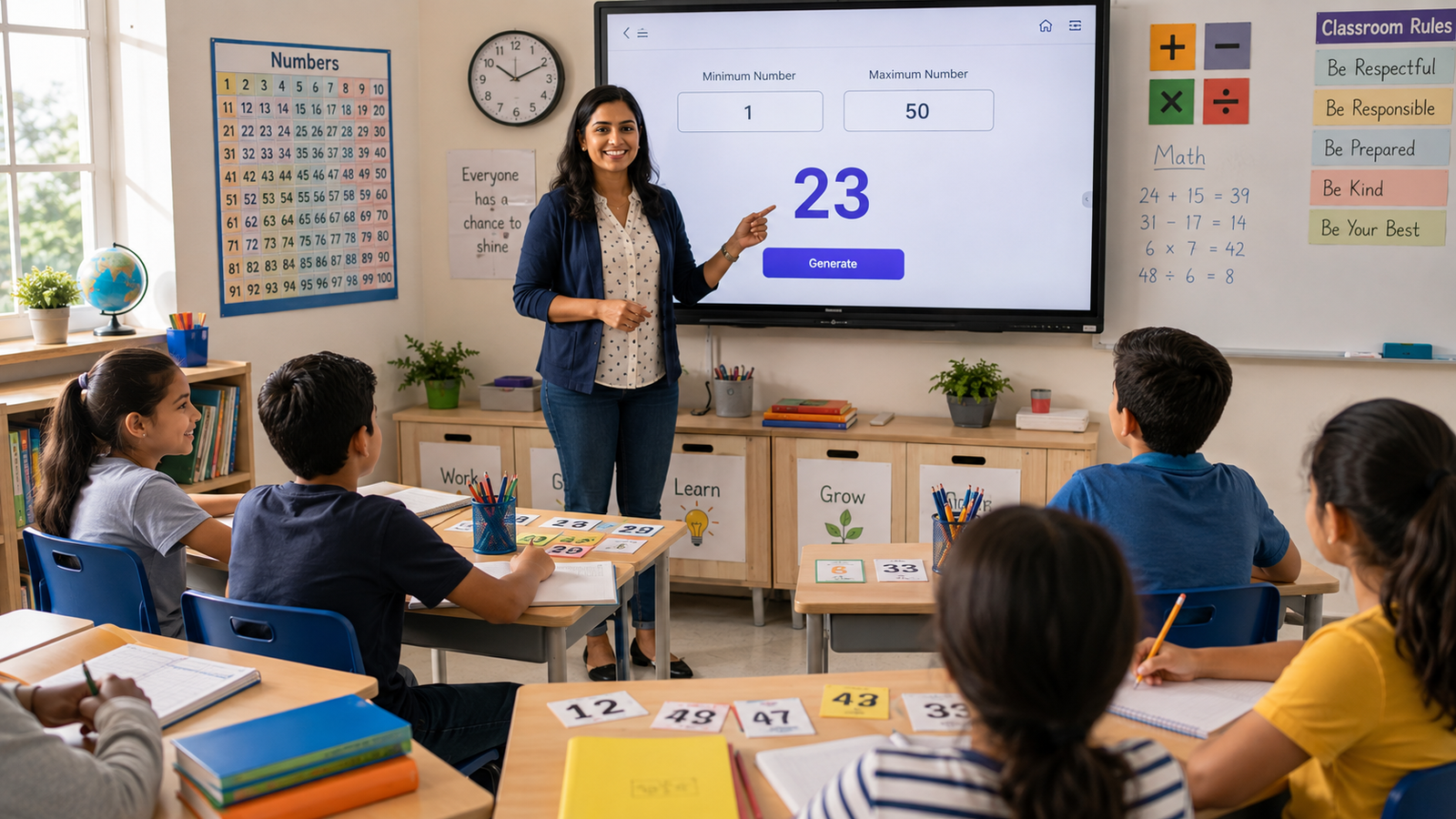
A classroom is full of small decisions. Who should answer the next question? Which group should present first? What number should students use for a quick math challenge? Which activity should come next? Teachers make dozens of choices like these during an ordinary school day, and making every selection manually can become repetitive.
Random numbers offer a simple way to make some of those decisions quicker, fairer, and more interesting. Instead of repeatedly choosing the same confident students or spending time deciding an order, a teacher can assign numbers and let a random result make the selection.
This does not mean every classroom decision should be left to chance. Teaching still requires judgment, planning, and an understanding of individual students. Random selection simply becomes another practical tool that can add variety when the outcome does not need to be predetermined.
Why Random Selection Works Well in a Classroom
Students quickly notice patterns. If a teacher normally starts with the front row, chooses volunteers, or calls on students in alphabetical order, the class soon knows what to expect. That predictability is sometimes useful, but it can also make an activity feel routine.
Random selection introduces a small element of surprise. Students do not know which number will appear next, so they may stay more attentive during an activity. It can also make participation feel less personal because the teacher is not visibly favoring one student over another.
For quick classroom activities, teachers can use the RandomCount Random Number Generator to select a number within a chosen minimum and maximum range. A teacher can match those numbers with students, questions, topics, tasks, or rewards depending on the activity.
1. Choose Students for Questions
One of the simplest uses is selecting students to answer questions. Give every student a number based on the class register or another temporary numbering system. If there are 28 students, for example, set the range from 1 to 28 and generate a number.
The student connected to that number gets the next question. After the answer, generate another number for the following question.
This method can help move participation beyond the students who always raise their hands first. Quiet students have a chance to participate too, while the selection process remains easy to understand.
However, teachers should still use judgment. A student may be uncomfortable speaking publicly, require an accommodation, or simply be having a difficult day. Random selection should support a classroom, not override the teacher's awareness of individual needs.
2. Create Quick Mental Math Challenges
A random number generator can turn an ordinary math lesson into a flexible practice activity. Instead of preparing every number before class, generate values as students work.
Suppose students are practicing multiplication. Generate two numbers from 2 to 12 and ask the class to multiply them. For addition practice, choose a larger range. For younger learners, keep numbers small enough to match their current skill level.
You can also create comparison questions. Generate two numbers and ask which is larger, find the difference, identify whether each number is odd or even, or ask students to round them to the nearest ten.
The same basic tool can therefore support several lessons without requiring a completely new activity each time.
3. Randomize Quiz Question Numbers
Quizzes do not always need to move from question one to question ten in order. If you have a worksheet, textbook exercise, or question bank, assign each question a number and generate the next question randomly.
This works particularly well for revision sessions. Students cannot simply prepare for the next obvious question because any numbered question may appear.
For example, if your revision sheet contains 30 questions, generate a number between 1 and 30. Discuss that question, mark it as completed, and move to another number.
If you want to avoid repeating completed questions, use a method that prevents duplicates or keep a visible list of numbers that have already appeared.
4. Decide Presentation Order
Presentation day often begins with the same uncomfortable question: “Who wants to go first?” Sometimes nobody volunteers. Other times several groups want the same position.
Random numbers provide a neutral solution. Number each student or group, then generate numbers to determine the presentation order.
The important part is explaining the process before the draw begins. Students should know that the order is being selected randomly and that the same method applies to everyone. This makes the activity easier to accept than changing the rules halfway through.
5. Build Number Guessing Games
A number guessing game requires almost no preparation. Choose a range such as 1 to 50 and generate one hidden number. Students take turns guessing while the teacher provides clues such as “higher” or “lower.”
For younger students, use a smaller range. Older students can work with negative numbers, decimals, or larger values when appropriate.
You can make the activity educational by adding rules. Students might have to explain why their next guess is logical, estimate the remaining range, or calculate how many possible numbers are left after each clue.
A simple guessing game then becomes practice in reasoning, estimation, and number sense rather than pure luck.
6. Assign Classroom Tasks Fairly
Some classroom responsibilities are popular; others are not. Random selection can help distribute suitable routine tasks without repeatedly asking for volunteers.
Create a numbered list of age-appropriate responsibilities such as collecting worksheets, organizing materials, cleaning the board, distributing supplies, or helping prepare an activity. Generate a number when a task needs to be assigned.
Teachers can also rotate students and tasks separately. The goal is not to make responsibility completely random, but to prevent the same students from automatically receiving the same jobs every time.
7. Add Variety to Writing Prompts
Random numbers are useful outside mathematics too. A language teacher can prepare numbered characters, locations, objects, emotions, or situations. Students generate numbers and combine the corresponding items into a writing prompt.
Imagine three lists: characters, places, and problems. A student might randomly receive an astronaut, a railway station, and a missing suitcase. Another might receive a chef, a mountain village, and a mysterious letter.
Because the combinations are unpredictable, students begin with a creative constraint instead of staring at an empty page wondering what to write.
Random prompts can also work for speaking practice, storytelling, drawing exercises, and vocabulary activities.
8. Use Numbers for Classroom Games
Many classroom games become easier when numbers control part of the activity. Number vocabulary words and randomly choose the next word. Number review topics and let the generator decide the category. Create numbered challenges for a quick end-of-lesson game.
The randomness should add excitement without making the rules confusing. Students should always understand what each number represents before the selection happens.
If the activity requires something more visual, a teacher could also use a Dice Roller for dice-style classroom games. Choosing the right tool depends on whether you need a flexible number range or the familiar limits of dice.
9. Practice Probability With Real Results
Probability can feel abstract when students only read examples from a textbook. Generating repeated random results gives them data they can actually observe.
Choose a range from 1 to 10 and generate results repeatedly. Students can record how often each number appears. Before starting, ask them to predict what the results might look like after 10, 50, or 100 trials.
Afterward, compare the results with their predictions. Students may notice that a small sample does not always look perfectly balanced even when every value has the same intended chance of being selected.
This creates a natural discussion about randomness, frequency, probability, and sample size.
For a deeper technical explanation, the MDN guide to random number generators explains the basic difference between pseudorandom number generators and cryptographically secure generators. This level of detail is more suitable for teachers, older students, or anyone curious about how digital randomness works.
This creates a natural discussion about randomness, frequency, probability, and sample size.
To understand how digital random number generators work, you can read the MDN guide to Random Number Generators, which explains pseudorandom numbers and how computer-generated randomness works.
10. Create Quick Brain Break Challenges
Not every classroom use has to be academic. Random numbers can also help choose short brain breaks between demanding activities.
Create a numbered list containing simple options such as stretch for 30 seconds, take five deep breaths, draw something in one minute, solve a riddle, organize the desk, or complete a quick movement challenge.
Generate a number and let the corresponding activity become the class break. Because students do not know what will be selected, even a familiar routine can feel slightly different.
Tips for Using Random Numbers Responsibly
Random selection works best when students understand its purpose. Explain what is being randomized, what range is being used, and what happens after a number is generated.
Avoid using random selection for decisions involving grades, discipline, accessibility, student safety, or situations where individual circumstances matter. Those decisions require appropriate educational judgment rather than chance.
It is also useful to match the tool to the task. Random numbers are ideal when each option can be represented clearly by a number. If you are working directly with names or several written choices, a list-based picker may be more convenient.
Most importantly, randomness should make an activity simpler or more engaging. If it creates unnecessary confusion, a normal teacher-led choice is probably better.
Random Numbers Are a Small Tool With Many Uses
A random number generator may look like a very basic digital utility, but its simplicity is exactly what makes it flexible. The same tool can help choose students, create math questions, organize presentations, generate writing prompts, run games, explore probability, and select classroom activities.
Teachers do not need to redesign an entire lesson around randomness. Start with one small use, such as choosing a quiz question or creating two numbers for a mental math exercise. Once students understand the process, it can become a convenient part of classroom routines.
The best use of random numbers is not replacing thoughtful teaching. It is removing a few unnecessary decisions while adding fairness, variety, and a little anticipation to everyday learning.
Frequently Asked Questions
Can teachers use a random number generator for student selection?
Yes. Teachers can assign each student a number and randomly generate one when choosing participants. The method is useful for suitable classroom activities, although teachers should always consider individual student needs and accommodations.
How can random numbers be used in math lessons?
Teachers can generate numbers for addition, subtraction, multiplication, division, rounding, comparison, probability, estimation, odd-and-even exercises, and number guessing games.
Can random numbers help make classroom activities fair?
They can provide a neutral selection method when every eligible option should have the same opportunity to be chosen. Teachers should explain the rules beforehand so students understand the process.
Are random numbers useful outside math classes?
Yes. They can be connected to writing prompts, vocabulary exercises, presentation order, classroom jobs, discussion questions, revision topics, games, and creative challenges.
Should every classroom decision be randomized?
No. Random selection is best for low-stakes activities where chance is appropriate. Decisions involving learning needs, safety, discipline, assessment, accessibility, or student wellbeing should rely on professional judgment.
What is the easiest way to start using random numbers in class?
Start with a simple activity. Set a number range that matches your questions, students, or tasks, generate one result, and connect that result to the numbered item on your prepared list.
Final Thoughts
Random numbers may be simple, but they can bring useful variety to everyday classroom activities. From choosing students and creating quick math challenges to organizing presentation order, writing prompts, games, and revision exercises, teachers can use randomness in many practical ways without making lessons complicated.
The key is to use random selection where it genuinely makes sense. It should support fairness, participation, and engagement rather than replace a teacher’s judgment. Start with one small activity, see how students respond, and gradually introduce it into other suitable classroom routines.
When used thoughtfully, a simple tool like the RandomCount Random Number Generator can turn routine classroom decisions into quick, fair, and engaging learning moments.