
You have 1,000 characters to introduce yourself, answer a question, write a short description, or complete an online form. But how much can you actually write?
That isn't a fixed conversion. Spaces, punctuation marks, numbers, and symbols can also affect the final count. Here's a practical way to understand the difference and plan your writing without constantly guessing.
How Many Words Is 1000 Characters?
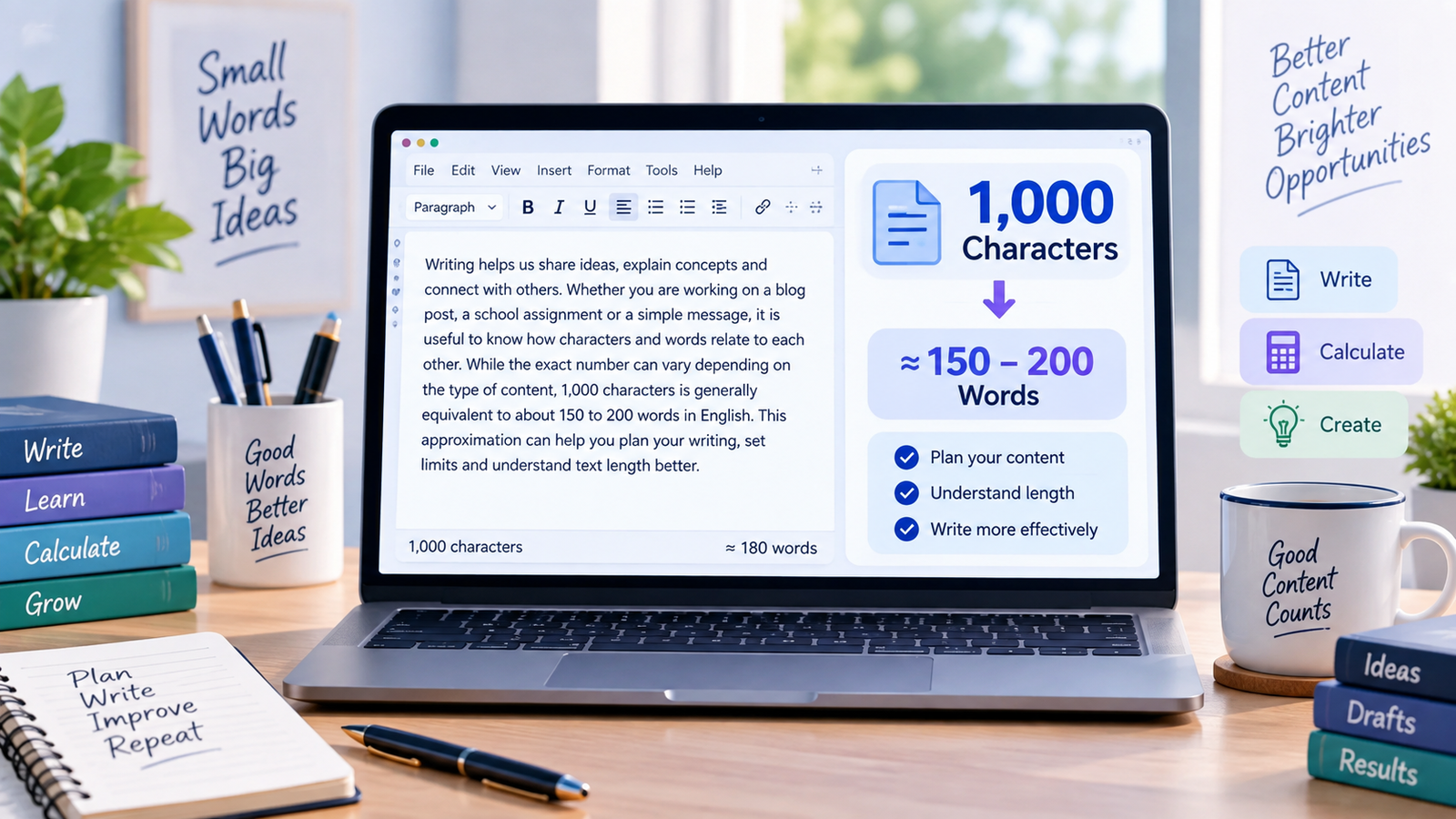
Quick answer: 1,000 characters will usually give you approximately 150–200 words of everyday English. If you need one simple number for planning before you start writing, roughly 170 words is a sensible target when spaces are included.
The exact result depends on your writing style. Consider the words “I like this book.” Most of them are short. Now compare that sentence with one containing words such as “communication,” “professional,” and “recommendation.” Both sentences can communicate a simple idea, yet the second uses considerably more characters.
So there isn't one exact formula that turns characters into words. A 1,000-character sentence made mostly of short words will contain more words than one filled with longer terms.
The 170-word figure is only a planning estimate, not a standard conversion. Two pieces of text with the same 1,000-character count can have noticeably different word counts because their average word length and punctuation differ.
Simple example: If a 1,000-character response contains 170 words, that works out to an average of about 5.9 characters per word when spaces and punctuation are considered. Another 1,000-character response might contain only 150 words if it uses longer words, or more than 180 words if it relies heavily on short words. This shows why character-to-word conversions are estimates rather than fixed calculations.
Why Doesn't 1000 Characters Always Equal the Same Number of Words?
Word count and character count measure text in different ways, so the two numbers should not be treated as interchangeable. If you want a deeper explanation, this guide on character count vs word count explains how each measurement works and when it matters.
For example, “cat” and “information” each count as one word. However, one contains only three letters while the other contains eleven. Write a paragraph filled with short words and you'll fit considerably more words inside a 1,000-character limit.
Several everyday writing habits can change the result:
- Word length: Shorter words generally increase the number of words you can fit.
- Punctuation: Commas, periods, apostrophes, question marks, and similar marks take up characters.
- Numbers: Dates, prices, phone numbers, and other numerical information add to the total.
- Writing style: Technical and academic language often contains longer words than casual conversation.
1000 Characters With Spaces vs Without Spaces
This is where character limits can become confusing. Two counters can display different numbers for the same paragraph because one may include spaces while another excludes them.
For most online character limits, the safest assumption is that spaces are included unless the platform says otherwise. However, counting rules are not universal, so the instructions for the specific form, application, or website should always take priority.
When spaces count toward the 1,000-character limit, fewer characters remain available for actual letters. As a practical estimate, you might fit around 150–180 words in ordinary writing.
If spaces aren't included in the character total, the same 1,000-character allowance can often accommodate closer to 180–200 words or more, especially when you use short, simple words.
Don't rely on an estimate when you're submitting something with a strict maximum. Paste the finished text into the RandomCount Word Counter to see the actual word and character totals before submitting it.
1000 Characters to Words: Quick Conversion Table
If you're planning around a character limit, these ranges give you a quick starting point. The actual word count can be higher or lower depending on the words, spaces, and punctuation in your text. It assumes ordinary English writing and should not be treated as an exact conversion.
| Character Limit (Including Spaces) | Approximate Word Count |
|---|---|
| 100 characters | 15–20 words |
| 250 characters | 40–50 words |
| 500 characters | 75–100 words |
| 1,000 characters | 150–200 words |
| 1,500 characters | 225–300 words |
| 2,000 characters | 300–400 words |
| 5,000 characters | 750–1,000 words |
Think of these numbers as a rough guide, not a rule. If your writing uses mostly short words, you may fit more words into the same character limit. Longer or more technical words will usually reduce the total.
What 1,000 Characters Can Look Like in Practice
Imagine you're filling out an application form with a 1,000-character limit. A response of about 170 ordinary English words may fit within that space, but the exact number can change. For example, a response containing short words such as “I enjoy learning new skills and working with people” will use fewer characters per word than a response filled with longer terms such as “professional communication” or “additional qualifications.”
That's why the safest approach is to use 150–200 words as a starting estimate, then check the finished response with a character counter before submitting it.
Suppose your draft contains 165 words and your character counter shows 980 characters including spaces. That means the text fits within a 1,000-character limit, leaving about 20 characters available. If the same draft reaches 1,040 characters, you would need to shorten a few words or remove unnecessary phrases.
What Does a 1000 Character Limit Look Like?
Numbers are useful, but it can be easier to think about the amount of information you can realistically communicate. A 1,000-character limit is enough for a few short paragraphs, a detailed profile description, a concise answer to a form question, or a brief explanation of one main idea.
For example, you could use 1,000 characters to explain why you are applying for an opportunity, describe a small project, introduce yourself briefly, or answer a form question with a reason and one supporting example. The space is enough to communicate a focused idea, but it rewards concise writing rather than several unrelated points.
It isn't enough space for a detailed article or a long story. If you're writing inside a fixed field, focus on one central point first. Add the supporting details that matter, then remove repeated explanations and filler.
For example, suppose an application asks why you're interested in a particular opportunity. Instead of spending the opening 200 characters repeating the question, begin with your reason. Use the remaining space for one specific example and a clear closing thought. You'll communicate more without exceeding the limit.
How to Check Exactly How Many Words Are in 1000 Characters
Estimating is helpful before you write. Once you've written the text, however, there's little reason to guess.
Want an exact result instead of an estimate? Use the free word and character counter to check your text before submitting it. Seeing the word count alongside characters with and without spaces makes it easier to identify which measurement a character-limited form is using.
- Check the total number of words.
- Look at the character count with spaces.
- Compare it with the character count without spaces.
- Edit the text until it fits the limit required by the website, form, or assignment.
For strict limits, checking the finished text is safer than relying only on a words-to-characters estimate. You can also read this guide on how to count characters accurately to understand how spaces, line breaks, symbols, and other text elements can affect a count.
Do Spaces Count as Characters?
Usually, yes—but the rule depends on the platform you're using. A space occupies a position in a text string, so many websites and applications include it in the character total. Punctuation marks and symbols may count as well.
This distinction matters more than it might seem. A paragraph can contain hundreds of spaces. If you're close to a strict 1,000-character maximum, checking the wrong measurement could leave you over the limit even though your estimated word count looks fine.
Always read the instructions next to the text field. If they don't explain whether spaces are included, use a counter that displays both measurements and test the field before final submission.
Where Are 1000 Character Limits Commonly Used?
Before writing, check whether the limit is measured in characters with spaces, characters without spaces, or words. This is especially important for forms and platforms that use different counting rules.
You may encounter character limits in places such as:
- Application forms: Short answers may have a fixed character allowance.
- Profile descriptions: Some websites limit the amount of text you can place in a bio or introduction.
- Online forms: Feedback boxes and short-response fields may restrict the number of characters.
- Short messages: Certain services limit how much text can be submitted in a single field.
- Content fields: Websites and publishing systems may set limits for descriptions or other short-form content.
Character limits aren't just numbers; they influence how much information you can fit into a message and how directly you need to write. This overview of character limits provides additional context on how length restrictions affect digital writing.
The important thing isn't to fill every available character. A clear 820-character response is often better than stretching a simple idea to 999 characters just because the space exists.
A character limit can make editing easier because it forces you to look at what really needs to stay. After writing your first draft, remove repeated ideas and shorten phrases that take up space without adding much meaning. Keep the details that help the reader understand your point. Your final response will usually become easier to read as well as shorter.
How to Write Better Within a 1000 Character Limit
Start by writing what you actually want to say rather than watching the counter after every sentence. Constantly checking the number can interrupt your train of thought. Once the first draft is complete, check the character count and edit from there.
If you're over the limit, look for phrases that can be shortened without changing the message. “Due to the fact that” can often become “because.” Repeated examples can be reduced to one strong example. Long introductions can usually be trimmed.
Don't remove useful details simply to make the writing look shorter. The goal is concise communication, not incomplete communication.
If you're writing for a specific online service, it's also worth checking that service's official help documentation because character limits and counting rules can change. For general language and writing guidance, resources such as Purdue Online Writing Lab can help you improve clarity and sentence structure.
Characters and Words Are Not Interchangeable
If a form says “maximum 1,000 characters,” entering 1,000 words would be far beyond the allowed length.
The reverse is also true. A 1,000-word article contains several thousand characters, depending on its vocabulary and formatting.
Whenever you're working with a strict requirement, identify the measurement first: words, characters with spaces, or characters without spaces. That small check can save you from rewriting an entire response at the last minute.
For example, if your draft is slightly over a 1,000-character limit, you do not necessarily need to remove an entire sentence. Replacing a longer phrase with a shorter one, removing repeated words, or cutting an unnecessary introductory phrase may be enough to bring the text under the limit while keeping the main message intact.
Frequently Asked Questions
How many words is 1000 characters with spaces?
In everyday English, 1,000 characters including spaces is usually around 150–180 words. The exact total changes depending on the average length of your words and how much punctuation you use.
How many words is 1000 characters without spaces?
When spaces are excluded from the character total, the same text can contain more words than a 1,000-character count that includes spaces. However, there is no reliable fixed word range because the result depends on word length, punctuation, numbers, and the counting method used.
Is 1000 characters the same as 1000 words?
No. Characters are individual letters, numbers, spaces, punctuation marks, and symbols, while words contain multiple characters. One thousand characters normally represents only a fraction of 1,000 words.
How many paragraphs is 1000 characters?
There is no fixed number of paragraphs in 1,000 characters. Depending on how you structure the text, 1,000 characters could be written as one longer paragraph or several shorter paragraphs. For a form or application, two to four short paragraphs can often make the response easier to read.
Does a space count as a character?
Usually, yes. Many character counters include spaces in the total character count, but some platforms may count characters without spaces. Always check the specific platform's instructions or use a counter that shows both measurements.
Final Answer
So, how many words is 1000 characters? For typical English writing, a useful estimate is 150 to 200 words, with around 170 words being a practical starting point when spaces are included.
Because the exact number depends on your wording, punctuation, and whether spaces are included in the limit, use the estimate for planning and check the finished text with a character counter when the limit is strict.
RandomCount offers more than text counting. You can explore RandomCount's free online tools and learn how the platform is designed to make common digital tasks simpler.