
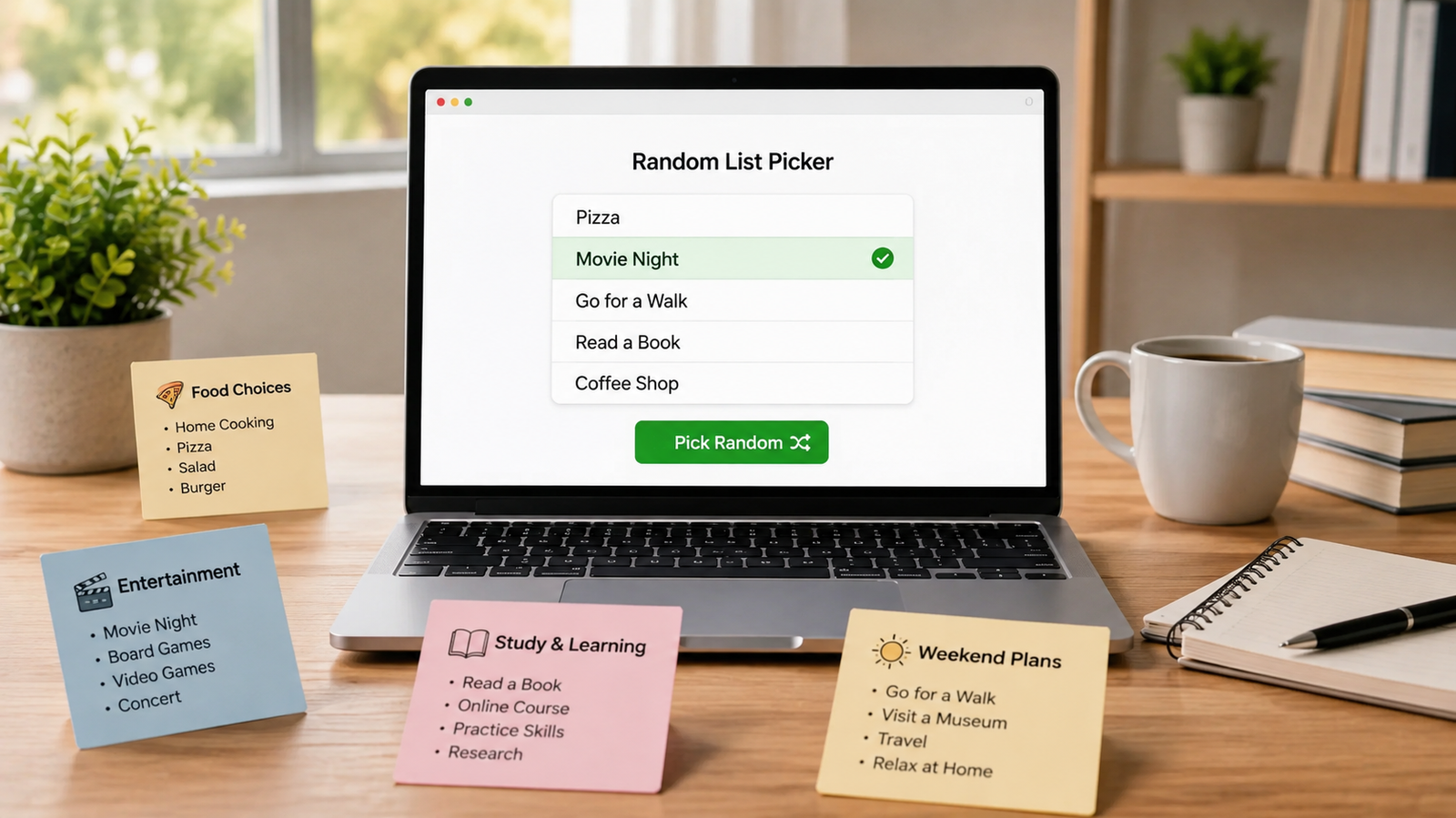
Choosing between a few options sounds easy until you actually have to make the choice. What should you eat tonight? Which movie should you watch? Which task should you finish first? Where should you go this weekend? These are small decisions, but when you keep going back and forth between several good options, even a simple choice can take longer than it should.
That is where a random list picker can be useful. Instead of comparing the same options again and again, you make a shortlist and let the picker choose one. It is a simple way to stop overthinking a small decision and move on.
When the decision is low-stakes, accepting the selected option can be an easy way to move forward without spending more time comparing choices.
A random list picker can make simple choices easier by reducing unnecessary hesitation. For more insight into how having too many options can affect decisions, explore this research on choice overload from Frontiers in Psychology.
What Is a Random List Picker?
A random list picker is an online tool that selects an item from a list you provide. You might enter five restaurants, ten movies, several weekend activities, or a list of tasks that need to be completed. The tool then chooses one item from those options.
Instead of going back and forth between the same choices, you can put them into a list and let the picker select one. You still decide which options belong on the list; the tool simply helps with the final choice.
This can be especially helpful when you already know that most of the choices are perfectly fine. The problem is not finding an option. The problem is spending too much time choosing between them.
When you already have your options ready, RandomCount's Random List Picker gives you a quick way to select one without manually choosing from the list.
Why Small Decisions Can Take More Time Than Expected
Modern life comes with a constant stream of little choices. We choose what to wear, what to eat, which message to answer first, what content to watch, which task to start, and where to go after work.
One small decision usually is not a big deal, but making dozens of choices throughout the day can add up.
Choosing can take longer when several options look almost equally good. Research on decision-making has examined how factors such as workload, uncertainty, complexity, and the number of alternatives can affect the process. A random picker does not solve decision fatigue, but it can give you a practical stopping point when the choices are already acceptable.
The goal is not to avoid making decisions. It is simply to use a quick method when several options are already acceptable and you do not have a strong reason to prefer one over another.
Once your options are ready, you can use RandomCount's Random List Picker to make the final selection.
How a Random List Picker Helps
One practical benefit is that it gives you a clear point to stop comparing. Imagine you have six movies on your watchlist. You have already checked trailers and reviews, but none of them stands out. Instead of scrolling for another ten minutes, put the titles into a random list picker and watch whichever one it selects.
If the selected movie suddenly sounds less appealing, you can always pick again. The point is not to find the “perfect” movie; it is to avoid spending another ten minutes opening trailers, reading reviews, and changing your mind.
5 Practical Ways to Use a Random List Picker
1. Decide What to Eat
Food is one of the easiest places to use random selection. If everyone at home has a different suggestion for dinner, make a short list of the acceptable choices and let the picker select one.
You can also keep a short weekday meal list ready in advance. Add meals you already enjoy and can easily prepare, then use the picker on evenings when you do not want to think about dinner. That saves you from starting the same decision from scratch every night.
This works particularly well when you are not looking for a specific meal and just want to avoid the familiar “What should we eat?” conversation.
2. Choose a Weekend Activity
Free weekends can sometimes create another type of problem: too many possibilities. You could watch a movie, visit a café, go for a walk, play a game, clean the house, visit friends, or explore somewhere nearby.
Create a list of activities that you genuinely enjoy and use random selection to choose one. Keeping separate indoor and outdoor lists can make this even more practical, since you can remove options that do not fit the weather or your available time.
The result may not be your first choice, but that is not necessarily a bad thing. It can push you toward an activity you liked before but kept putting off.
3. Pick Your Next Study Task
Students often have several assignments, chapters, revision topics, and practice exercises waiting for them. When everything feels equally important, deciding where to begin can become a distraction.
For smaller study tasks, create a list of the work you are ready to do and randomly choose one. For example, if reviewing vocabulary, solving practice questions, and revising notes are all reasonable next steps, let the picker decide where to start. You can then get to work instead of spending more time trying to create the perfect order.
This approach should not replace deadlines or a proper study schedule. Important assignments should still be prioritized according to due dates and difficulty. Random selection is better used when several tasks have roughly the same priority.
4. Select a Movie, Book, or Game
Entertainment is a natural fit because choosing one movie, book, or game usually does not have serious consequences.
Instead of browsing hundreds of titles, make a shortlist of movies you have already been meaning to watch. The same idea works for books, podcasts, games, or even a playlist.
If you regularly struggle to choose what to watch, keep a small “watch next” list instead of searching from scratch every evening. When you finish one title, use the picker on that shortlist and move directly to the next option.
5. Break a Tie Between Friends
Sometimes a group agrees on everything except one small detail. Two restaurants sound good. Two games are available. Two people want to choose the next activity.
Rather than having the same discussion again, put the acceptable options into a random list picker. If each option appears once, the selection gives each listed option the same chance of being picked.
For a more visual experience, you can also use RandomCount's Spin Wheel when you want everyone to see the selection happen on screen.
How to Make a Better Random List
A random picker can only choose from the options you give it, so the list matters. Remove anything you would reject, anything unavailable, and anything that does not fit the situation. Random selection works best when every remaining option is genuinely acceptable.
Keep the options reasonably similar. If you put “watch a movie” alongside “take a two-week vacation,” the list is not really comparing equal choices.
It also helps to avoid adding several entries that represent essentially the same choice. If “pizza,” “pizza from Restaurant A,” and “pizza from Restaurant B” are separate entries, pizza has three chances to appear while “sushi” has only one. If you want each type of meal to have an equal chance, use one entry for each meal type.
Random Does Not Mean Careless
There is an important difference between using randomness for a small decision and using it for a serious one.
A random picker can be useful for choosing between acceptable entertainment options or deciding which simple task to tackle first. It should not be used as a substitute for careful thinking when the decision involves health, safety, legal matters, major financial commitments, or other serious consequences.
A simple rule is to use randomness only after you have decided that the available options are acceptable. If the consequences could affect your health, safety, finances, legal position, or future, make the decision based on the relevant facts instead.
Random Selection Can Also Make Activities More Fun
It can also be used simply for fun. Make a short list of activities you enjoy and let the picker decide which one you will try this time.
Teachers can prepare a list of classroom activities and let the class choose one. Families can create a weekend challenge list, while friends can make a shortlist of places they already want to visit. Content creators can also keep a list of planned topics and randomly choose which one to work on next.
You control the options, while the picker decides which one appears. That small element of surprise can make a familiar activity feel less repetitive.
If you need numbers instead of list items, RandomCount's Random Number Generator can be useful for number-based selections.
A Simple Method for Everyday Choices
If you want to make random selection part of your routine, keep the process simple.
- Write down the options you are genuinely willing to choose.
- Remove anything unavailable or unsuitable.
- Make sure the options are reasonably comparable.
- Enter the list into a random picker.
- Check the selected option and make sure it still works for the situation.
- If the result is still suitable for the situation, accept it and move forward.
Once the picker gives you a result, you have a clear starting point instead of another round of comparing options. For simple choices, that can be enough to get moving.
When You Should Choose for Yourself
Random selection is useful, but it is not always the right approach. If one option has clear advantages, choose it. If you have important personal preferences, consider them. If a choice affects another person's health, safety, money, or future, take the time to evaluate it properly.
The best use of a random list picker is when you honestly feel that several options are good enough and you simply need help making the final call.
Frequently Asked Questions
What is a random list picker?
A random list picker is an online tool that selects one item from a list of options you provide. It can be used for simple decisions involving food, activities, entertainment, study tasks, and other low-stakes choices.
Is a random list picker actually random?
A digital random picker uses a programmed random-selection process to choose from the entries you provide. The exact method can vary between tools, so for everyday decisions it is best understood as a convenient way to make a selection without manually choosing one yourself.
What can I use a random list picker for?
It is most useful when you have already made a shortlist and several options seem equally suitable. You can use it for meals, entertainment, study tasks, group activities, or other everyday choices.
Can students use a random list picker?
Yes. Students can use one to choose between similar study tasks, revision topics, practice activities, or break-time activities. Important deadlines should still take priority over a random selection.
Can a random list picker help with decision fatigue?
It may help you spend less time comparing options in some everyday situations by giving you a clear choice. It is simply a convenient way to handle certain low-stakes decisions, rather than a solution or treatment for decision fatigue.
Should I use randomness for important decisions?
No. Decisions involving health, safety, significant money, legal matters, or major life consequences deserve careful consideration. A random picker is best used as a tie-breaker for simple choices.
Final Thoughts
Small decisions do not always deserve a long debate. Sometimes you already have a perfectly good list of choices; you just need a simple way to pick one.
A random list picker can turn that shortlist into a quick decision. Whether you are choosing dinner, a movie, a weekend activity, or a low-priority study task, it can give you a clear starting point when several options already seem good enough.
The key is knowing when randomness makes sense. For important decisions, take the time to compare the consequences and choose carefully. For simple choices where the options are already acceptable, a random pick can help you make the call and move on.
Have a few acceptable options but cannot decide? Add them to RandomCount's Random List Picker and use the selected option as a simple starting point for your next low-stakes choice.