
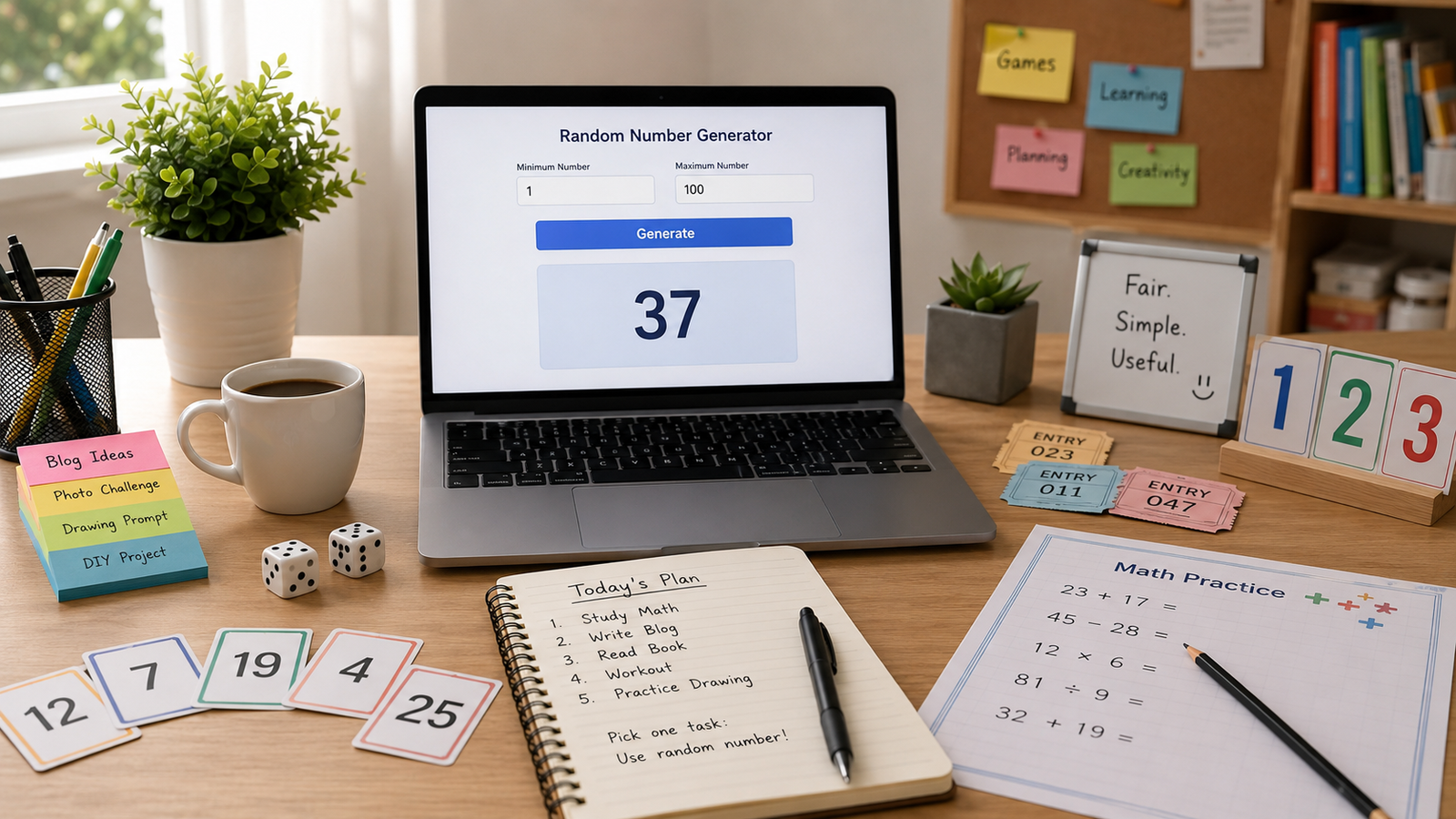
A random number generator may look like one of the simplest tools on the internet. You enter a minimum number, choose a maximum number, click a button, and receive a result. But that small function can be surprisingly useful in everyday situations.
Whenever several options are equally acceptable, choosing one manually can take more time than it should. We may overthink a simple choice, repeatedly select familiar options, or unintentionally favor one person over another. A random number can remove that unnecessary decision-making and give every numbered option a chance.
You can try the Random Number Generator on RandomCount when you need an instant number within a custom range. Here are ten practical ways to put it to use.
1. Choose Who Goes First in a Game
The beginning of a board game, card game, or friendly competition often starts with the same question: who goes first? Instead of debating or relying on the same person every time, assign each player a number.
For example, if six friends are playing, number everyone from 1 to 6 and generate a number within that range. The matching player starts. You can repeat the process when you need to determine a second player, team captain, or playing order.
This approach is particularly convenient when a game does not already include dice, cards, or another method for deciding the starting order.
2. Make Classroom Participation More Varied
Teachers often need to decide who will answer a question, read a passage, demonstrate a solution, or present first. Calling on students manually can sometimes result in the same confident students participating again and again.
One simple alternative is to assign each student a number and generate a random result when appropriate. Random selection should not replace a teacher's judgment, but it can add variety to low-stakes classroom activities.
For more classroom-specific examples, read our guide on how teachers can use random numbers in the classroom.
3. Create Quick Math Practice Questions
Students and parents can also use random numbers to make repetitive math practice less predictable. Suppose a student is practicing multiplication. Generate two numbers from 1 to 12 and multiply them. Generate another pair for the next question.
The same idea works for addition, subtraction, percentages, estimation, and mental arithmetic. Instead of following questions in a fixed textbook order, each result creates a small new challenge.
You can adjust the number range as skills improve. A younger learner might work between 1 and 20, while an older student can choose larger values.
4. Pick a Task When You Cannot Decide Where to Start
Sometimes the difficult part of a busy day is simply choosing the first task. You may have five small jobs that are equally important, yet spend ten minutes deciding which one deserves attention first.
Write the tasks as a numbered list and generate a number. If the result is 4, begin with task number 4. This is most useful when the tasks genuinely have similar priority.
Deadlines, emergencies, and important responsibilities should obviously be handled with normal judgment. Random selection is better suited to choices where several outcomes are equally reasonable.
5. Build Random Exercise or Practice Challenges
A number generator can make personal practice sessions more varied. Imagine you have ten drawing exercises, eight guitar drills, twelve vocabulary topics, or six sports practice activities. Number them and let a random result decide what comes next.
You can even use two results: one for the activity and another for the duration or number of repetitions. The unexpected combination can make familiar practice feel less repetitive.
This method works best as a way to add variety, not as a replacement for professional training plans or safety guidance.
6. Select a Giveaway Entry by Number
When a small giveaway receives many valid entries, manually choosing one person can create questions about favoritism. A numbered entry list provides a straightforward alternative.
First, remove entries that do not meet the stated rules. Then assign a number to every eligible participant and generate a result within the final range. The number points to the selected entry.
Keeping the final eligible list and recording the selection process can also make the result easier to explain. Our detailed guide on picking giveaway winners fairly covers this process in more detail.
7. Add Variety to Creative Projects
Creative work sometimes slows down because there are too many possibilities. A writer might have seven story ideas. A photographer might have ten subjects to practice. A designer might want to experiment with several layouts.
Numbering those possibilities and generating a result can give you an unexpected starting point. You still decide what to do with the idea; randomness simply chooses which door to open first.
This can be especially useful during practice sessions where the goal is exploration rather than producing a specific final result.
8. Organize Event Activities
Random numbers are handy during family gatherings, school events, office activities, community programs, and casual parties. They can determine presentation order, select question numbers, choose table activities, or decide which challenge comes next.
Suppose an event has 20 numbered trivia questions. Rather than asking them from 1 through 20, generate a number for each round and remove questions after they have been used.
A simple change like this can make a planned activity feel less predictable without making the event difficult to manage.
9. Choose Samples for Informal Checks
Imagine you have 50 non-critical records, practice items, or test entries and want to inspect a few of them without always choosing the first items on the list. Numbering the entries and generating several numbers can provide a quick sample for an informal review.
This approach can be useful for personal projects, demonstrations, practice datasets, or routine spot checks. However, formal research, regulated auditing, scientific sampling, and high-stakes statistical work require proper sampling methods rather than a casual online selection.
To understand how computer-generated random values work, read the MDN guide to Math.random(), which explains how pseudorandom numbers are generated in JavaScript and where they are commonly used.
For developers interested in the technical side of browser-based pseudorandom numbers, the MDN documentation for Math.random() provides a useful introduction to generating and scaling pseudorandom values.
10. Settle Small Everyday Choices
Not every decision deserves serious thought. Which numbered recipe should you try? Which chapter should you review again? Which drawer should you organize first? Which challenge should your group play next?
When all the available choices are acceptable, a random result can settle the question in seconds. This is where random tools are often most useful: not for making important life decisions, but for removing friction from small ones.
For choices based on names or written options instead of numbers, you can also explore RandomCount's other selection tools and choose the format that fits your situation.
When Should You Not Use Random Selection?
Randomness is useful only when the possible outcomes are appropriate to leave to chance. It should not decide medical treatment, financial investments, legal matters, personal safety, hiring decisions, or other choices that require evidence, expertise, rules, or careful judgment.
It is also worth understanding that not every digital random-number method is suitable for security-related purposes. For example, MDN notes that JavaScript's Math.random() is not cryptographically secure and recommends cryptographic methods for security-sensitive applications.
The simple rule is to use random selection for convenience, fairness, variety, practice, and entertainment when every available outcome is already acceptable.
Frequently Asked Questions
What is a random number generator?
A random number generator is a tool that produces a number from a defined range. Online generators can be useful for games, practice activities, numbered selections, classroom exercises, and other situations where an unpredictable result is useful.
Can I generate a number between my own minimum and maximum values?
Yes. A range-based random number generator lets you enter minimum and maximum values before generating a result, making it suitable for both small and large numbered lists.
Can students use random numbers for studying?
Yes. Students can use generated numbers to create math questions, select revision topics, choose practice exercises, or add variety to study sessions.
Is a random number generator useful for games?
Yes. It can help choose the first player, determine playing order, select numbered challenges, or introduce unpredictable elements into casual games.
Should important decisions be made randomly?
No. Decisions involving health, money, safety, legal matters, employment, or other serious consequences should be based on appropriate information and professional judgment rather than random selection.
Final Thoughts
A random number generator does much more than produce numbers for games. It can help teachers vary classroom participation, students create practice questions, friends organize games, creators challenge their usual habits, event organizers change activity order, and everyday users settle small choices without overthinking.
The real value is simplicity. Prepare your options carefully, give each one a number, choose the correct range, and let the result handle the final selection. When the decision is small and every option is reasonable, a little randomness can save more time than you might expect.